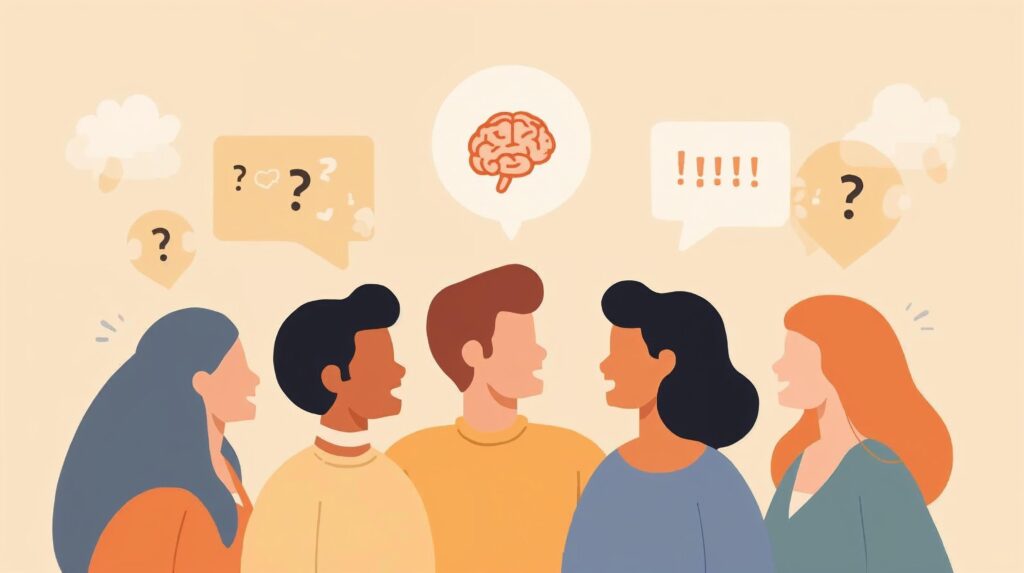
Let’s be honest for a second.
Most people say they hate drama and gossip. But somehow, when something interesting is happening between people, we want to know the details.
Who said what.
Who did what.
What happened next.
Even if we try not to listen, our brain still gets curious.
You might notice this in everyday life. Someone whispers, “Did you hear what happened to them?” and suddenly your attention wakes up. You were not interested a second ago, but now your brain wants the story.
This does not mean you are a bad person. It mostly means your brain is doing something it has been trained to do for thousands of years.
Our brains are built to pay attention to people.
Our Brain Is Wired to Watch Other People
Humans are social creatures. That simply means we survive and live in groups.
Thousands of years ago, living in a group meant safety. Your group helped you find food, protect each other, and raise children. Being part of the group was very important.
Because of this, our brain developed a strong interest in social information.
Social information just means information about other people.
Who can be trusted.
Who is fighting.
Who is helping others.
Who might cause trouble.
Knowing these things helped our ancestors survive. If someone in the group was dishonest or dangerous, it was useful to know. If someone was helpful and kind, that was useful too.
So our brain became very good at paying attention to what people do.
Even today, that part of our brain is still active.
Gossip Is Basically Social Information
When we hear the word gossip, we usually think of something negative. But in psychology, gossip can simply mean talking about other people who are not present.
Not all gossip is mean or harmful.
Sometimes it sounds like this:
“Did you hear Maria got promoted?”
“I heard they’re getting married.”
“Someone said he’s starting a new business.”
These are still forms of gossip. They are simply updates about other people’s lives.
In fact, researchers believe gossip helped early human groups share important information quickly. Instead of everyone learning things the hard way, people could simply talk about it.
For example:
“Don’t trust him, he cheats people.”
“She’s very generous.”
“They are good hunters.”
This helped people understand who was safe to be around.
So gossip, at its core, is really just social learning. Social learning means we learn by observing or hearing about other people.

Drama Grabs Our Attention
Drama usually involves conflict between people.
Conflict simply means disagreement, tension, or problems between individuals.
And our brain loves to pay attention to conflict.
Why?
Because conflict can signal danger or change.
If two people in a group are fighting, it could affect everyone. It might change friendships, alliances, or trust.
Our brain treats this as important information.
That’s why dramatic stories catch our attention so quickly.
Think about movies or TV shows. Many of them are built around conflict.
Someone betrays someone.
Someone hides a secret.
Someone breaks a promise.
Without conflict, most stories would feel boring.
Our brain wants to understand what will happen next.
Drama and Gossip Trigger Curiosity
Another reason we pay attention to gossip and drama is curiosity.
Curiosity is the feeling that pushes us to learn something new.
Our brain naturally likes filling in missing information.
If someone says:
“I can’t believe what happened yesterday.”
Your brain instantly wants to know what happened.
It feels unfinished. Like a puzzle with missing pieces.
Psychologists sometimes call this the information gap. This simply means our brain notices when we are missing information, and it pushes us to find the answer.
Drama creates a lot of these gaps.
Who started the fight?
What really happened?
Who is telling the truth?
Your brain wants the full story.
Our Brain Also Enjoys Emotional Stories
Drama often comes with strong emotions.
Anger.
Jealousy.
Love.
Betrayal.
These emotions make stories more memorable.
Our brain pays more attention to emotional events than neutral ones. Emotional simply means something that makes us feel strongly.
For example, you might forget a normal day at work. But you will probably remember the day two coworkers had a big argument.
The emotional intensity makes the memory stronger.
So when drama happens, our brain treats it like something worth remembering.
Gossip Can Help Us Understand Social Rules
Another interesting thing about gossip is that it teaches us about social behavior.
When we hear stories about what people did, we also learn what society thinks is acceptable or not.
For example:
“If you cheat people, others will avoid you.”
“If you help people, they will respect you.”
“If you lie, people might lose trust.”
Gossip often contains these lessons.
It quietly teaches us what behaviors are rewarded and what behaviors are criticized.
In a way, gossip can act like a social guidebook.
It helps people understand the unwritten rules of a community.
But Too Much Drama Can Be Draining
Of course, there is a downside.
While our brain may be curious about drama, too much of it can be stressful.
Constant conflict, rumors, and negativity can make people feel anxious or exhausted.
Our brain might be interested in drama, but it does not mean it is always healthy to stay in it.
That’s why some people choose to step away from environments filled with constant gossip or conflict.
Curiosity is natural. But protecting your peace is also important.
So Why Does Our Brain Love Drama and Gossip?
When you step back and look at it, the answer is pretty simple.
Our brain is built to pay attention to people.
Drama and gossip contain three things our brain naturally finds interesting:
Social information – updates about people and relationships.
Conflict – which signals possible change or danger.
Emotion – which makes stories more memorable.
Add curiosity on top of that, and it becomes hard for the brain to ignore.
So the next time you find yourself listening to an interesting story about someone else’s life, don’t be too hard on yourself.
Your brain is simply doing what human brains have been doing for thousands of years.
The key is knowing when to listen… and when to step away.
References
Dunbar, R. (2004). Gossip in evolutionary perspective. Review of General Psychology.
Foster, E. K. (2004). Research on gossip: Taxonomy, methods, and future directions. Review of General Psychology.
Baumeister, R. F., Zhang, L., & Vohs, K. (2004). Gossip as cultural learning. Review of General Psychology.
Feinberg, M., Willer, R., & Schultz, M. (2014). Gossip and ostracism promote cooperation in groups. Psychological Science.
Loewenstein, G. (1994). The psychology of curiosity: A review and reinterpretation. Psychological Bulletin.
Thanks for reading.
If you prefer reading on Medium, this article is also available there.
You May Also Like:
Understanding The Online Disinhibition Effect: Why Do People Become Meaner Online
Why People Stay in Toxic Relationships: The Psychology Behind Staying