Have you ever noticed how certain reactions in your daily life just happen automatically, almost without thinking? You hear your phone notification and instantly feel the urge to check it.
You walk into a cinema and suddenly crave popcorn, even if you just ate.
Or maybe you feel nervous the moment you step into a classroom where you once had a difficult exam.
These moments may seem random, but they are not. Your brain is quietly making connections behind the scenes, linking experiences together based on what you’ve learned over time.
You’re Not Alone
If you experience these automatic reactions, you’re not alone. In fact, this is something all humans do.
Our brains are designed to recognize patterns and form associations because it helps us predict what might happen next.
Psychologists have found that much of our behavior is learned through repeated experiences, especially when emotions or meaningful events are involved.
This means that many of your habits, reactions, and even preferences are not random—they are learned responses shaped by your environment.
Let’s Break It Down
Classical conditioning shows up in different ways in everyday life, and understanding these patterns can help you recognize your own behaviors more clearly.
One common type is emotional conditioning, where a certain place, person, or situation triggers a specific feeling. For example, a student who once experienced embarrassment during a class recitation may feel anxious every time they enter that classroom, even if nothing stressful is happening anymore.
Another type is habit-based conditioning, where your body reacts automatically due to repeated routines. A good example is feeling sleepy as soon as you lie down on your bed, even if it’s still early in the evening. Over time, your brain has learned to associate the bed with sleep, so the reaction becomes automatic.
Lastly, there is cue-triggered behavior, where specific signals lead to certain actions. For instance, you might always reach for snacks when watching Netflix or feel the urge to scroll through your phone when you hear a notification sound. These cues become powerful triggers because they have been repeatedly paired with a behavior.
The Psychology Behind It
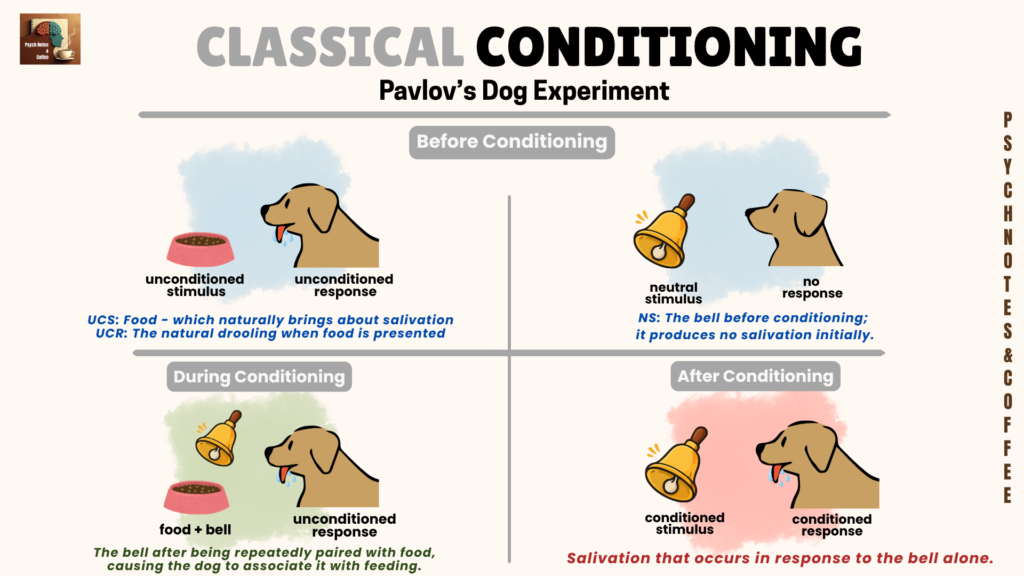
To understand why this happens, we go back to the concept of classical conditioning, first studied by the Russian physiologist Ivan Pavlov.
In simple terms, classical conditioning happens when a neutral stimulus—something that originally has no meaning—gets paired with a meaningful stimulus that naturally causes a reaction. After repeated pairings, the neutral stimulus alone can trigger the same reaction.
In everyday life, this process happens constantly. For example, your phone notification sound may not have meant anything to you at first. But over time, it became associated with messages, social interaction, or important updates. Eventually, the sound alone is enough to create a feeling of urgency or excitement.
This is why students may feel nervous just by seeing an exam paper, employees may feel stressed when they hear an email notification, and people at home may feel relaxed when they play their favorite music.
The brain learns patterns and starts responding in advance, even before the actual event happens.
The Hidden Factors at Play
What makes classical conditioning stronger is how often and how intensely these pairings happen.
Repetition plays a big role. The more often two things occur together, the stronger the connection becomes. For example, if you always eat while watching shows, your brain will strongly associate entertainment with eating.
Emotions also strengthen conditioning. Experiences that involve stress, fear, excitement, or happiness are more likely to stick in your memory and form strong associations. This is why a single embarrassing moment can make you anxious in similar situations later on.
Another factor is lack of awareness. When you don’t realize that your behavior is being triggered by certain cues, it becomes automatic and harder to change.
Your environment also matters. Doing the same activity in the same place repeatedly—like studying on your bed—can create confusing associations, such as linking your bed with stress instead of rest.
Simple Strategies That Work
The good news is that these learned patterns can be changed.
Since they were learned, they can also be unlearned or reshaped with intentional effort.
One of the most effective strategies is changing your environment. Try to assign specific spaces for specific activities. For example, use your bed only for sleeping and rest, and study at a desk. This helps your brain form clearer and healthier associations.
Another strategy is breaking the association between certain cues and behaviors. If you notice that you always snack while watching shows, try to watch without food or replace the habit with something else like drinking water. Over time, the connection between watching and eating will weaken.
You can also create new, positive pairings. For example, if studying feels stressful, you can pair it with something enjoyable like listening to calm music or studying in a comfortable, well-lit space. This helps your brain start associating studying with a more positive experience.
Finally, practice awareness. Pay attention to your triggers. Ask yourself what happened right before you felt a certain urge or emotion. This simple habit can help you recognize patterns and take control of your reactions.
Real-Life Scenarios
If you find yourself constantly checking your phone, it may be helpful to reduce exposure to triggers by turning off non-essential notifications.
This teaches your brain that not every sound requires immediate attention.
If you feel anxious in certain places, try gradual exposure. Spend short, calm periods in that environment while doing something relaxing.
This can help your brain form new, less stressful associations.
If you often crave food during certain activities, consider replacing the habit with something healthier, like drinking water, chewing gum, or taking short movement breaks.
Over time, your brain will learn a different response.
When to Seek Help
While classical conditioning is a normal part of human learning, there are times when the reactions it creates can become overwhelming.
If you experience intense anxiety, panic, or behaviors that feel difficult to control, it may be helpful to seek support from a mental health professional.
They can guide you through structured techniques to safely change these patterns.
Here’s What Matters Most
Classical conditioning explains why many of your daily reactions feel automatic.
Your brain is constantly forming connections based on repeated experiences, linking cues with emotions and behaviors.
While this can sometimes lead to unhelpful habits, it also means you have the ability to reshape those patterns.
With awareness and small changes, you can retrain your brain to respond in healthier and more intentional ways.
Simple Action Plan (5-Day Challenge)
To start applying this in your life, try a simple five-day challenge.
On the first day, identify one habit you want to change, such as checking your phone too often.
On the second day, observe what triggers this behavior.
On the third day, practice pausing before reacting to the trigger.
On the fourth day, replace the habit with a healthier alternative.
On the fifth day, repeat the new behavior consistently to strengthen the new pattern.
Change doesn’t have to happen all at once—small, consistent steps like these can quietly reshape your habits over time.
You may start with these five days, and let each small win build momentum toward lasting change.
Where Do You Go From Here?
Take a moment to reflect on your daily routines. What is one habit you have that might be the result of conditioning? What do you think triggers it?
Understanding your patterns is the first step toward changing them—and you might be surprised by how much control you actually have.
References
- American Psychological Association. (2020). APA Dictionary of Psychology
- Pavlov, I. P. (1927). Conditioned Reflexes
- Schacter, D. L., Gilbert, D. T., & Wegner, D. M. (2011). Psychology
- OpenStax. (2020). Psychology 2e
- Myers, D. G. (2013). Psychology
If you enjoyed this topic, you might also like:
- The Devastating Reality of Prolonged Grief Disorder
- Exhibitionist Disorder Secrets: What’s Really Driving the Behavior
- “I Know I’m Right”… Or Am I? The Psychology Behind Believing What We Want
More psychology articles are also available on my website.
If you prefer reading on Medium, this article is also available there.