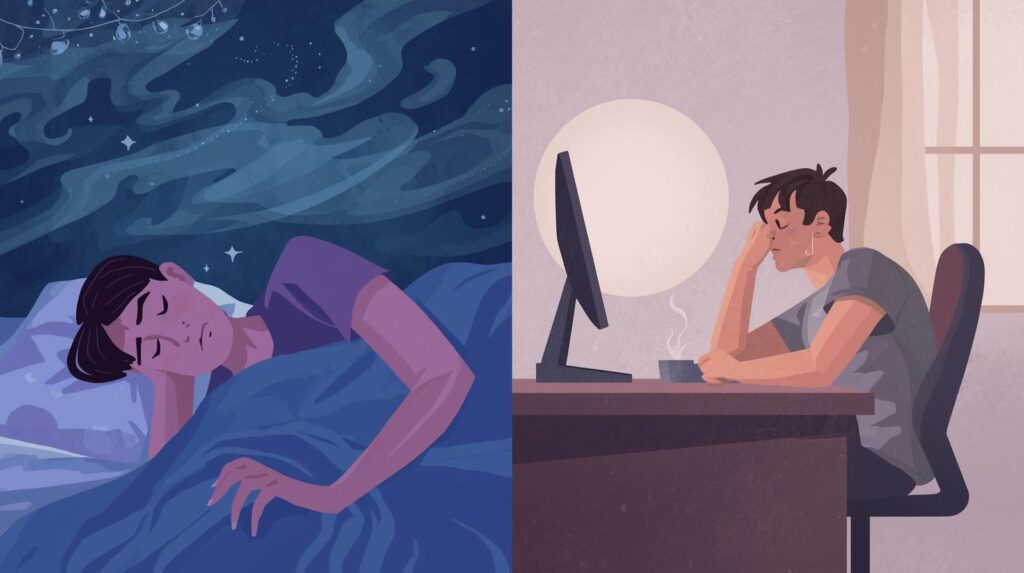
There are nights when you go to bed early, do everything “right,” and still wake up feeling like you barely slept at all.
Maybe you notice it slowly. The heavy mornings. The headaches that don’t quite make sense. The constant urge to nap, even after what should have been a full night’s rest. Or maybe someone has mentioned your snoring—loud, uneven, sometimes followed by silence that feels a little too long.
It’s easy to brush off. Stress. A busy week. Maybe just bad sleep habits.
But sometimes, it’s something your body has been trying to tell you for a while.
What Is Obstructive Sleep Apnea, Really?
Obstructive Sleep Apnea (OSA) isn’t just about snoring.
Medically, it falls under sleep-related breathing disorders. While it’s not classified in the DSM-5-TR (because that manual focuses on mental disorders), it is recognized in sleep medicine as a condition where breathing repeatedly stops and starts during sleep due to a blocked airway.
In simpler terms:
Your body is trying to breathe while you sleep—but something physically gets in the way.
This blockage usually happens when the muscles in your throat relax too much. The airway narrows or closes, and for a few seconds (sometimes longer), breathing pauses. Your brain senses the drop in oxygen and briefly wakes you up just enough to restart breathing.
Most people don’t even remember these awakenings.
But they can happen dozens… even hundreds of times in one night.
What It Feels Like (Beyond the Stereotypes)
When people think of sleep apnea, they often imagine loud snoring and nothing more.
But living with it feels different.
It’s not just “being tired.” It’s a kind of exhaustion that doesn’t go away. A fog that lingers no matter how much you sleep.
You might wake up feeling like you’ve been holding your breath. Or with a dry mouth, like you spent the night breathing through it. Sometimes there’s a dull headache that fades slowly as the day goes on.
During the day, things feel… off.
You lose focus more easily. Conversations slip past you. Small tasks take more effort than they should. You might feel irritable without knowing why, or strangely low in energy even during moments that used to excite you.
And because it builds slowly, it’s easy to normalize it.
How It Shows Up in Real Life
Obstructive Sleep Apnea doesn’t always look dramatic. It often hides in everyday patterns.
Someone might fall asleep while watching a show, even if they weren’t that tired.
Another person might rely heavily on caffeine just to feel “normal.”
Some people wake up multiple times at night, thinking it’s stress or anxiety.
Others are told they snore loudly—or that they sometimes stop breathing, then gasp or choke.
It can also affect relationships in quiet ways. A partner might feel concerned, or simply struggle to sleep beside the noise. Over time, people might even start sleeping in separate rooms without fully understanding why.
At work or school, it can look like lack of motivation. But underneath, it’s often a body that hasn’t truly rested in a long time.
Why It Happens
At its core, Obstructive Sleep Apnea is physical.
The airway becomes blocked during sleep. This can be influenced by several factors:
- The natural structure of your airway (some people simply have narrower passages)
- Excess weight, which can add pressure around the neck area
- Relaxation of throat muscles during sleep
- Sleeping position, especially lying on your back
But it’s not just about anatomy.
There’s also a pattern: your body gets stuck in a cycle of disrupted sleep. Every time breathing stops, your brain has to “wake” you slightly to restart it. You never reach the deeper, restorative stages of sleep consistently.
So even if you sleep for 7–8 hours, your body experiences it as fragmented, low-quality rest.
Signs People Often Overlook
Not everyone notices the obvious symptoms. In fact, some of the most common signs are easy to dismiss:
- Waking up tired, even after enough hours of sleep
- Morning headaches
- Difficulty concentrating or remembering things
- Mood changes, like irritability or low motivation
- Dry mouth or sore throat in the morning
- Feeling unusually sleepy during the day
Sometimes, the loud snoring or breathing pauses are noticed by someone else before the person experiencing it realizes anything is wrong.
Why It Matters More Than We Think
It’s tempting to think of sleep apnea as just a sleep problem.
But sleep affects everything.
When your body doesn’t get enough oxygen during the night, and your sleep is constantly interrupted, it puts stress on your system. Over time, this can affect your heart, your metabolism, your mood, and your ability to function during the day.
It can increase the risk of accidents, especially when driving or doing tasks that require attention.
But beyond the physical effects, there’s also something quieter:
The slow erosion of how it feels to be present in your own life.
When you’re constantly tired, you’re not fully there. Not in conversations. Not in moments that matter.
Can It Get Better?
Yes—but not in an overnight, quick-fix kind of way.
The first step is awareness. Recognizing that what you’re feeling isn’t just “normal tiredness.”
From there, proper diagnosis usually involves a sleep study. It sounds intimidating, but it’s simply a way to observe how your body behaves during sleep.
Treatment depends on the cause and severity. For many people, it includes using a CPAP machine (a device that keeps the airway open with gentle air pressure). Others may benefit from lifestyle changes, positional therapy, or medical interventions.
It’s not always comfortable at first. Adjusting takes time.
But many people describe a quiet shift once treatment starts:
They wake up and, for the first time in a long time, feel rested.
Not dramatically different. Just… clearer. Lighter. More present.
A Final Thought
Sometimes, we blame ourselves for feeling tired, distracted, or unmotivated.
We tell ourselves to try harder. Sleep earlier. Push through.
But sometimes, the problem isn’t effort.
Sometimes, it’s that your body has been trying to rest… and hasn’t been able to.
And maybe understanding that is where things begin to change.
References
- American Academy of Sleep Medicine (AASM)
- National Heart, Lung, and Blood Institute (NHLBI)
- Mayo Clinic – Obstructive Sleep Apnea
- Sleep Foundation – Sleep Apnea Overview
- International Classification of Sleep Disorders (ICSD-3)
If you enjoyed this topic, you might also like:
- It’s Not Just a Bad Day: What Major Depression Really Feels Like
- Acute Stress Disorder: When the Mind Is Still in Survival Mode
- Caught in the Loop: What OCD Really Feels Like
More psychology articles are also available on my website.