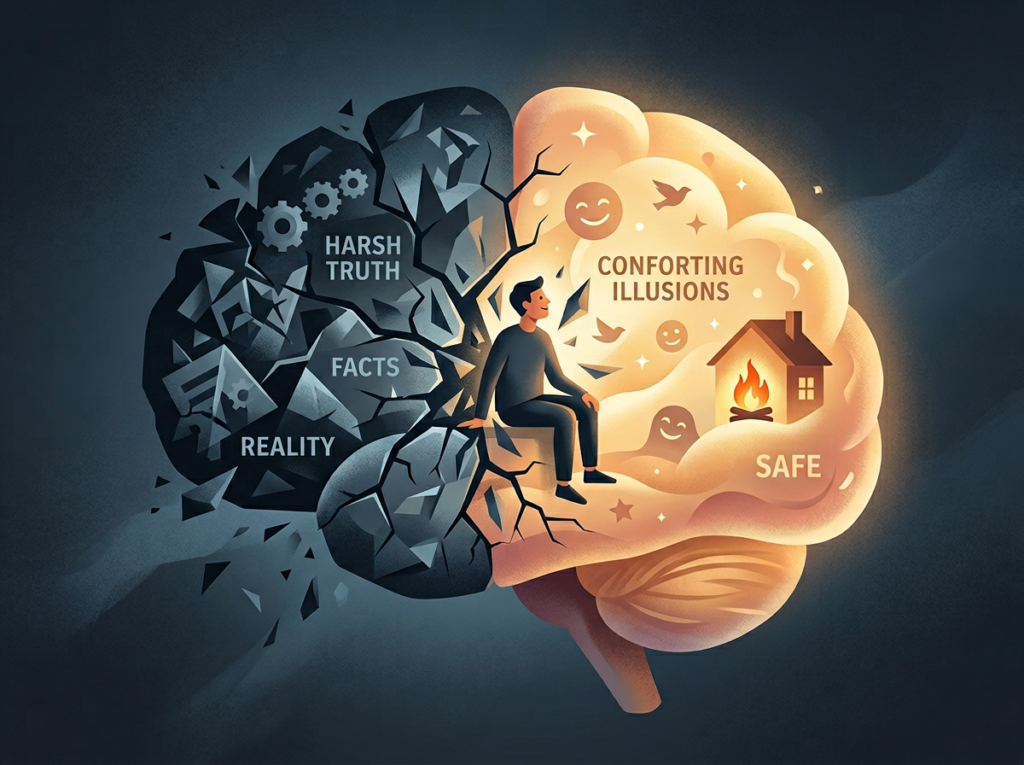
You’re in an argument with a friend. You’re both looking at the same facts—but somehow, you still end up on completely different sides.
Or maybe you’ve stayed in a situation—like a relationship, a course, or a job—longer than you should have, because you wanted it to work.
Deep down, you had doubts… but you pushed them aside. Why do we do this?
This is actually very normal. Our brains are not designed to always find the truth—they’re designed to protect us, reduce stress, and help us feel certain.
How This Shows Up in Real Life
Believing what we want doesn’t always look the same. It usually shows up in a few common patterns:
- The “Selective Attention” Pattern
You naturally focus on information that supports your belief and overlook anything that challenges it.
Example (Student Life):
You believe you’re “bad at presentations.” After one awkward presentation, that belief sticks. Even if you later do okay—or even well—you barely acknowledge it. Your mind highlights the negative and filters out the positive.
Over time, your belief feels more “real,” even if it’s incomplete.
- The “Emotional Investment” Pattern
You continue believing something because you’ve already invested time, effort, or emotion into it.
Example (Relationships):
You stay in a relationship that’s no longer healthy because you’ve already spent years in it. Admitting it’s not working would feel like “wasting” all that time.
So instead, your mind shifts the narrative:
“It’s not that bad.”
“We just need to try harder.”
- The “Gut Feeling = Truth” Pattern
You rely heavily on your feelings as proof, even when there’s little evidence.
Example (Daily Life):
You feel like someone doesn’t like you, so you interpret neutral actions—like short replies or a serious face—as confirmation.
Your feeling becomes your “evidence.”
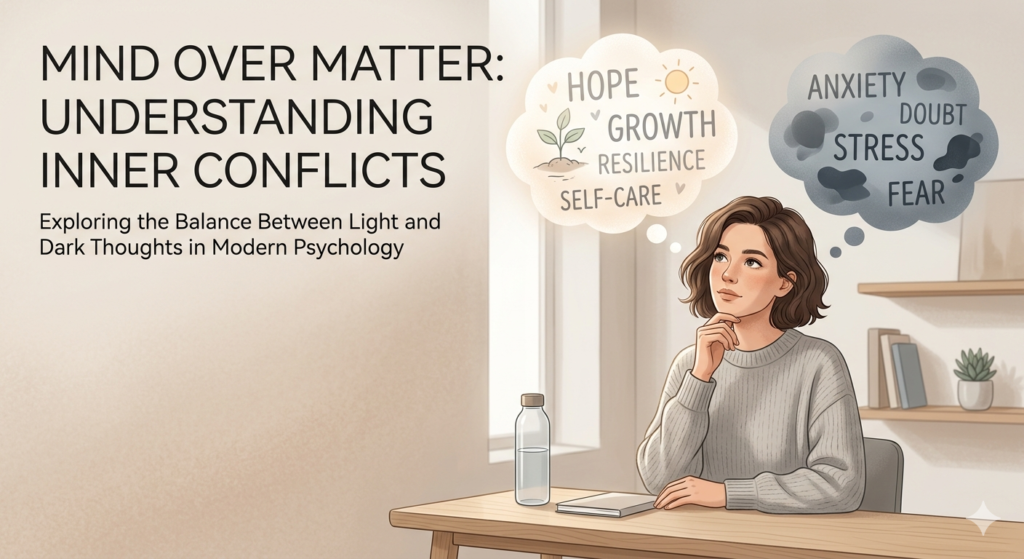
“Not every thought deserves belief— but we believe anyway.”
Explain the Psychology
Now let’s connect these patterns to key psychological concepts—but in a simple way.
Confirmation Bias
This is the tendency to search for, notice, and remember information that supports what you already believe.
Your brain does this automatically because it’s easier and faster than constantly re-evaluating everything.
Example (Work):
If you believe your boss is unfair, you’ll quickly notice every moment that supports that idea—but you might ignore times when they treat you fairly.
Over time, your belief feels stronger—not necessarily because it’s 100% true, but because your brain keeps reinforcing it.
Cognitive Dissonance
This happens when your beliefs and your reality don’t match—and that creates mental discomfort.
Instead of changing your belief (which can feel threatening), your brain often tries to reduce the discomfort by adjusting how you interpret the situation.
Example (Career):
You feel unhappy in your course, but you’ve already spent years studying it. Instead of changing direction, your mind might say:
“It’s normal to feel this way. Everyone struggles.”
This reduces discomfort—but may also keep you stuck.
Emotional Reasoning
This is when you treat feelings as facts.
It sounds simple, but it’s very powerful.
Example (Home/Personal Life):
“I feel like I’m a failure” → “I am a failure.”
The feeling becomes the conclusion, even without objective evidence.
What Makes It Worse
Certain everyday habits quietly strengthen this pattern:
- Echo Chambers
When you surround yourself with people or content that always agree with you, your beliefs go unchallenged.
This is common on social media, where algorithms show you what you already like.
- Fear of Being Wrong
Admitting you’re wrong can feel uncomfortable—it can affect your confidence and identit
So instead, your mind protects you by holding onto your current belief.
- Emotional Stress and Anxiety
When you’re overwhelmed, your brain prefers quick, emotionally-driven conclusions rather than careful thinking.
That’s why during stressful times, people become more rigid in their beliefs.
- Over-Attachment to Identity
Sometimes beliefs are tied to who you think you are.
Changing your belief can feel like losing a part of yourself.
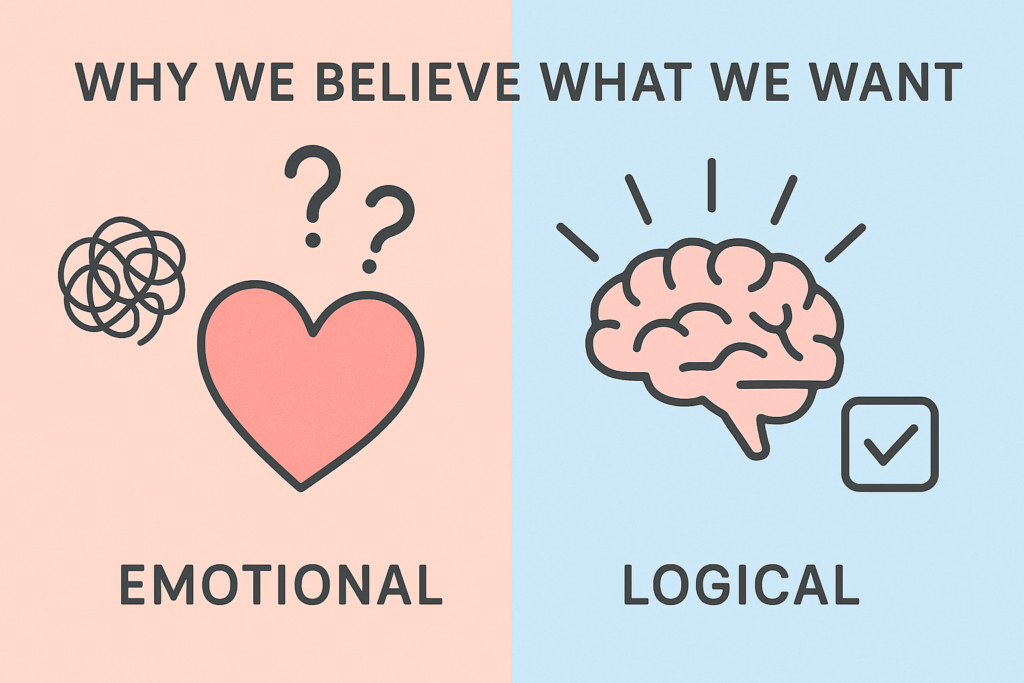
“Logic shows the truth. Emotion chooses the story.”
Practical Solutions (Actionable and Structured)
You don’t need to eliminate these patterns completely—that’s unrealistic.
But you can become more aware and flexible.
Mindset Shift: Aim for Accuracy, Not Comfort
Start asking:
“Do I want this to be true… or is it actually true?”
That small shift changes how you process information.
Daily Habit: Practice “Mental Pausing”
When you feel strongly about something:
Pause
Label the feeling (“I feel anxious”)
Ask: “What are the facts?”
This helps separate emotion from evidence.
Behavior Change: Actively Seek Disconfirming Evidence
Make it a habit to ask:
“What would prove me wrong?”
This strengthens critical thinking.
Social Strategy: Expand Your Perspective
Talk to people who think differently—not to argue, but to understand.
This reduces blind spots in your thinking.
If This Sounds Like You…
If you’re a student doubting yourself…
You might believe “I’m not smart enough.”
→ Start tracking actual performance (grades, feedback, improvements), not just how you feel after a bad day.
If you’re in a confusing relationship…
You might ignore red flags because you want things to work.
→ Focus on consistent behavior, not occasional effort or promises.
If you’re overthinking at work…
You might assume negative intentions without evidence.
→ Replace assumptions with questions:
“Did they actually say or show that?”

“It’s easier to fall into comforting illusions than to climb toward uncomfortable truth.”
When to Seek Help
If you notice that your beliefs are causing ongoing distress—like constant anxiety, self-doubt, or difficulty making decisions—it may be helpful to talk to a psychologist or counselor.
Sometimes, an outside perspective can help you see patterns that are hard to recognize on your own.
What to Remember
Believing what we want is not a failure of intelligence—it’s a natural function of the human mind.
Your brain is trying to protect you from discomfort, uncertainty, and emotional pain.
But growth happens when you gently question your own thinking.
You don’t have to reject your thoughts—you just have to be willing to examine them.
Simple Action Plan (5-Day Challenge)
Day 1: Identify one strong belief you currently hold
Day 2: List evidence that supports it
Day 3: List evidence that challenges it
Day 4: Ask someone for a different perspective
Day 5: Reflect: “Has my thinking become more flexible?”
Something To Think About
Think about one belief you’ve been holding onto lately.
Is it based on clear evidence—or is it something you want to be true?
You don’t need to answer right away.
But noticing the question is already a powerful first step.
Are you a student or simply curious? Feel free to check out my Facebook post about “Why We Believe What We Want“—it’s different from the blog version, as it’s designed specifically for students who want to take notes.
References
- American Psychological Association (APA) — Cognitive Bias and Decision Making
- Kahneman, D. (2011). Thinking, Fast and Slow
- Festinger, L. (1957). A Theory of Cognitive Dissonance
- Nickerson, R. S. (1998). Confirmation Bias: A Ubiquitous Phenomenon in Many Guises
- Stanford Encyclopedia of Philosophy — Belief Formation and Bias
- Tavris, C., & Aronson, E. (2007). Mistakes Were Made (But Not by Me)
If you enjoyed this topic, you might also like:
- Why People Stay in Toxic Relationships: The Psychology Behind Staying
- People Change More Than You Think—Here’s the Powerful Reason Why
- The Hidden Science of Secondhand Embarrassment
More psychology articles are also available on my website.