
There’s a moment some people know too well.
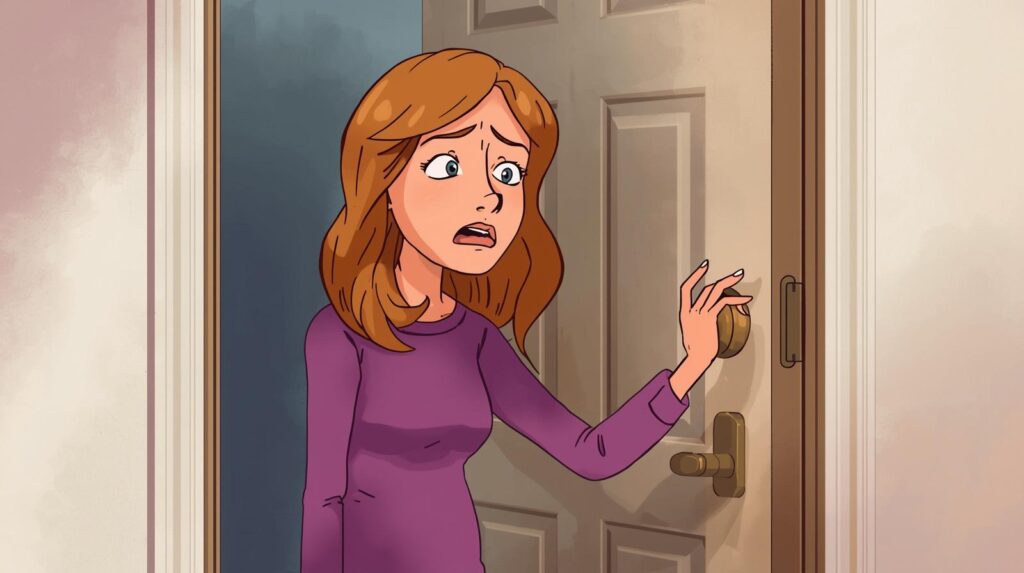
You leave the house, lock the door, and start walking away. Then something whispers in your mind… Did I really lock it?
You go back and check. It’s locked. You leave again.
But the thought comes back, louder this time. What if you didn’t check properly?
So you go back. Again.
And again.
At some point, it stops being about the door.
It becomes about the feeling that something is not quite right, and you can’t relax until it is.
That’s a small window into what living with Obsessive-Compulsive Disorder (OCD) can feel like.
What OCD Actually Is (DSM-5-TR, Explained Simply)
According to the DSM-5-TR (the diagnostic manual used in psychology), OCD is a condition where a person experiences:
- Obsessions – repeated, unwanted thoughts, urges, or images that cause anxiety
- Compulsions – repetitive behaviors or mental acts done to reduce that anxiety
These obsessions and compulsions are time-consuming or distressing enough to interfere with daily life.
In simpler terms:
Your mind throws thoughts at you that feel urgent and scary, even if you know they don’t make sense. And you feel driven to do something—anything—to quiet them down.
What It Feels Like (Beyond the Stereotypes)
Most people think OCD is just about being organized or liking things clean.
But it’s not about preference. It’s about pressure.
It feels like your brain is stuck on a loop you didn’t choose.
It feels like doubt that never fully settles.
It feels like needing certainty in a world that doesn’t offer it.
You might know the stove is off.
You might know your hands are already clean.
You might know you’re not a bad person.
But knowing isn’t enough.
Because OCD doesn’t operate on logic—it operates on fear and discomfort.
And the worst part?
The relief you get from checking, washing, or repeating something… only lasts for a moment. Then the cycle starts again.
How OCD Shows Up in Real Life
OCD doesn’t look the same for everyone. Sometimes it’s visible. Sometimes it’s completely hidden.
Here are a few ways it can quietly show up:
A student rereads the same paragraph over and over because it doesn’t feel “right,” even though they understand it.
Someone washes their hands until their skin becomes dry or painful, trying to get rid of a feeling of contamination.
A person avoids certain numbers, words, or actions because they’re convinced something bad might happen if they don’t.
Another person has intrusive thoughts about harming someone they love—thoughts they hate—and they spend hours mentally trying to “cancel them out.”
And that last one is important.
OCD thoughts are often the exact opposite of who the person is.
They are unwanted. Disturbing. Ego-dystonic—meaning they don’t align with the person’s values.
But OCD makes them feel important anyway.
The Patterns Behind OCD (Why It Happens)
OCD isn’t just random. There’s a pattern underneath it.
It usually starts with a thought—something small, strange, or uncomfortable.
Most people would brush it off.
But in OCD, the brain assigns meaning to that thought.
“Why did I think that? Does that mean something about me?”
That question creates anxiety.
Then comes the compulsion—checking, avoiding, repeating, or even mentally arguing with the thought. This reduces the anxiety temporarily.
And that temporary relief teaches the brain something powerful:
“This behavior works.”
So the cycle repeats.
Over time, the loop becomes stronger:
Thought → Anxiety → Compulsion → Relief → Repeat
There are also deeper factors at play.
Some people have a genetic tendency toward anxiety.
Some have brain circuits that are more sensitive to errors or uncertainty.
And many develop OCD patterns during stressful periods or major life changes.
But at its core, OCD is often about one thing:
a low tolerance for uncertainty, paired with a strong need to feel absolutely sure.
Signs People Often Overlook
Not all OCD looks obvious. Some forms are almost invisible.
People can have OCD without excessive cleaning or checking.
They might struggle entirely in their own mind.
Here are a few subtle signs:
- Constant mental reviewing (replaying conversations to check if you said something wrong)
- Seeking reassurance again and again, even after getting answers
- Avoiding certain situations “just in case”
- Feeling responsible for preventing harm, even in unrealistic ways
- Needing things to feel “just right,” not necessarily perfect, but complete
These can easily be mistaken for personality traits or overthinking.
But when they start taking up time, energy, and emotional space—it’s something more.
Why OCD Matters in Everyday Life
OCD doesn’t just stay in the background.
It can quietly shape decisions, relationships, and even identity.
Someone might avoid opportunities because they feel too uncertain.
They might struggle to be present in conversations because their mind is busy checking something internally.
They might feel exhausted from fighting thoughts that never seem to stop.
And sometimes, there’s shame.
Because from the outside, it can look like “overreacting” or “being irrational.”
But from the inside, it feels very real.
Understanding OCD matters because it helps us replace judgment with clarity.
Not just for others—but for ourselves.
What Recovery Actually Looks Like
Recovery from OCD isn’t about making the thoughts disappear completely.
It’s about changing your relationship with them.
One of the most effective treatments is Exposure and Response Prevention (ERP).
It sounds intimidating, but the idea is simple:
You face the thought or situation that causes anxiety—and don’t do the compulsion.
At first, the anxiety rises.
But over time, the brain learns something new:
“I can handle this without doing the ritual.”
That’s how the cycle slowly weakens.
Therapy, sometimes medication, and a lot of patience can help.
But progress is rarely linear.
There are good days. Hard days. Setbacks.
And that’s okay.
Because recovery isn’t about being perfect.
It’s about having more freedom than before.
A Quiet Reflection
OCD is often invisible.
It doesn’t always look like something dramatic.
Sometimes, it looks like a person who seems fine on the outside—but is constantly negotiating with their own mind.
If you’ve ever felt trapped in a loop of thoughts you didn’t ask for…
If you’ve ever done something not because you wanted to, but because you felt like you had to…
You’re not alone in that experience.
And more importantly—
that experience can be understood, and it can change.
Not all at once.
But slowly, in ways that matter.
📚 References
- American Psychiatric Association. (2022). Diagnostic and Statistical Manual of Mental Disorders (DSM-5-TR)
- National Institute of Mental Health (NIMH): Obsessive-Compulsive Disorder
- International OCD Foundation (IOCDF)
- Abramowitz, J. S. (2006). Understanding and Treating Obsessive-Compulsive Disorder
- Rachman, S. (2002). A cognitive theory of compulsive checking
If you enjoyed this topic, you might also like:
- It’s Not Just a Bad Day: What Major Depression Really Feels Like
- Acute Stress Disorder: When the Mind Is Still in Survival Mode
- Why Our Brain Loves Drama and Gossip
More psychology articles are also available on my website.