
Imagine walking into your living room after a long day. You want to relax, maybe make a cup of tea, but you trip over a pile of boxes. Your desk is buried under old papers. Clothes peek out from corners, cables spill over the counter. You feel tired, even before you sit down.
This is more than clutter—it’s mental weight. Every object you’ve been holding onto carries energy: a little anxiety, a pinch of guilt, a dash of nostalgia. And slowly, it drains your focus, your patience, even your joy.
You may have told yourself, “I’ll deal with this later”, yet later never seems to come. That pile keeps growing, and with it, a quiet, persistent sense of overwhelm.
You’re Not Alone
Hoarding isn’t rare. Studies suggest that 2–6% of adults struggle with hoarding tendencies severe enough to interfere with daily life. And countless others keep items out of habit or fear, even if it doesn’t reach clinical levels.
It’s not laziness or irresponsibility. Hoarding is a coping mechanism, often deeply tied to emotions, memories, or early experiences. Realizing that many others experience the same tension can be comforting. You’re not failing—you’re human.
How the Problem Shows Up (Patterns and Types)
Hoarding behaviors show up in several patterns:
- Sentimental Hoarding: Items are saved because they hold personal meaning—letters, gifts, childhood toys. You can’t bear to part with them because they feel like pieces of yourself.
- Practical or Utility Hoarding: Objects are kept because they might be useful someday. Old containers, electronics, broken appliances—all “just in case.”
- Digital Hoarding: Modern life adds emails, files, photos, and apps to the mix. Many struggle with the invisible clutter on phones and computers.
Most people experience a mix of these patterns. One day it’s the sentimental pile; the next, the practical stuff accumulates. Over time, these habits sap mental energy and create persistent stress.
First, Let Us Talk About It
Extreme hoarding is recognized in psychology as Hoarding Disorder (DSM-5-TR). Simply put: it’s when letting go of possessions feels unbearable, even if they have little practical value, and this causes significant distress or interference in life.
Think of it as your brain misjudging risk. The mind interprets discarding as potentially harmful, even threatening. What feels like “just keeping stuff” is often a deeply ingrained emotional survival strategy.
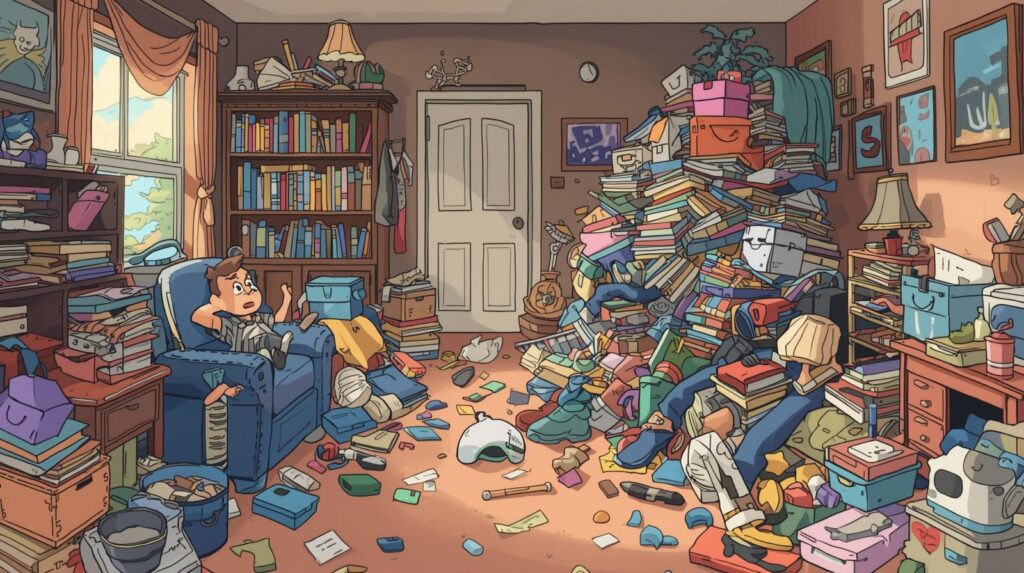
image created using Canva AI
What It Feels Like
Hoarding isn’t just about stuff—it’s about what the stuff represents.
You might feel:
- Anxiety when even considering tossing something.
- Guilt for letting go.
- Relief when saving an item, as if you’ve protected yourself.
It’s not laziness. It’s a mix of fear, attachment, and memory. People often hide their homes or feel embarrassed when others notice. Sometimes, the worry isn’t even about the object—it’s about losing a piece of yourself, your past, or a sense of control.
The Psychology Behind Hoarding
At its core, hoarding is about the brain’s emotional valuation system running on high alert.
- Memory and attachment: Items may represent people, experiences, or identity.
- Decision-making struggles: The thought “What if I need this?” creates paralysis.
- Stress coping: Saving items can provide temporary comfort, a sense of security in chaos.
Everyday examples:
- A student keeps every notebook because it feels like losing knowledge.
- A professional hoards files, afraid of losing proof or opportunities.
- Someone clings to gifts from past relationships, fearing the memory will fade.
Hoarding isn’t illogical—it’s emotional logic at work.
The Deeper Reasons Behind It
Hoarding develops from a combination of factors:
- Early life experiences: Growing up in scarcity or instability can make saving feel essential.
- Learned behaviors: Witnessing parents, siblings, or role models hoard normalizes the habit.
- Emotional regulation: Items can substitute for comfort or connection.
- Cognitive tendencies: Perfectionism, overestimating future need, and difficulty categorizing value all play a role.
It’s rarely one cause. Hoarding emerges from experience, brain wiring, and emotions intertwined over years.
Common Signs People Ignore
Some hoarding tendencies are subtle, easy to dismiss:
- Feeling anxious over tossing small items.
- Keeping things “just in case” that never get used.
- Taking on responsibility for other people’s possessions.
- Experiencing distress when someone suggests decluttering.
Recognizing these early can help prevent escalation.
How It Shows Up in Daily Life
Hoarding doesn’t usually appear all at once. It builds quietly, in small, almost invisible ways. At first, it might just look like a few extra items on your desk or a drawer that won’t close properly. You tell yourself it’s temporary. You’ll fix it when you have more time, more energy, or the “right mood.” But that moment keeps getting pushed further away.
Over time, daily routines start to feel heavier. You spend extra minutes—sometimes even hours—looking for things you know you have but can’t find. A simple task like getting ready in the morning becomes frustrating because your space feels crowded and disorganized. It’s not just about the clutter itself, but the mental effort required to move through it.
Social life can quietly shrink too. You might hesitate to invite friends over, even if you miss them. There’s a small voice saying, “Not until I clean up.” But cleaning up feels overwhelming, so you avoid both the task and the people. This creates a loop—more isolation, more attachment to your space, and less motivation to change it.
Work and productivity are also affected. Whether you’re studying or working from home, clutter competes for your attention. Even if you’re not consciously thinking about it, your brain is constantly processing the visual noise around you. It’s like having too many tabs open in your mind—everything slows down.
Then there’s the emotional weight. You might feel guilt every time you look at the pile. Or a quiet sense of shame, even if no one else sees it. Some days, you avoid looking at certain areas altogether because they feel too overwhelming. It’s not just physical clutter anymore—it becomes emotional clutter too.
And perhaps the most subtle effect is exhaustion. Not the kind that comes from doing too much, but from carrying too much. Too many decisions postponed. Too many items holding emotional meaning. Too many “I’ll deal with this later” moments stacking up.
Why This Cannot Be Ignored
At first glance, hoarding can seem like a harmless habit. After all, keeping things doesn’t immediately hurt anyone. But over time, the impact becomes deeper and more personal than it appears on the surface.
Your environment shapes how you feel more than you might realize. When your space is crowded or chaotic, your mind often mirrors that state. It becomes harder to think clearly, harder to relax, and even harder to feel at ease in your own home. The place that’s supposed to recharge you starts doing the opposite.
Relationships can also feel the strain. Loved ones may not always understand why it’s difficult for you to let go of things. They might see clutter where you see meaning, memory, or security. This difference in perspective can lead to tension, frustration, or even distance over time.
There’s also the quiet impact on how you see yourself. When clutter builds up, it can slowly chip away at your confidence. You might start thinking, “Why can’t I just fix this?” or “What’s wrong with me?” These thoughts aren’t true—but they feel real in the moment.
Energy is another big piece of the puzzle. Every item you hold onto requires a small amount of attention, whether you realize it or not. Multiply that by dozens, hundreds, or even thousands of items, and it becomes mentally draining. Letting go isn’t just about space—it’s about reclaiming that energy.
And perhaps most importantly, hoarding can keep you stuck. It ties you to the past, to “what ifs,” and to imagined future needs. It makes it harder to move forward, to create new experiences, or to feel fully present in your life.
This is why it matters—not because of the mess, but because of what it quietly takes from you.

image created using Gemini
Practical Ways to Fix This
Change doesn’t happen in one big moment. It happens in small, steady steps that feel manageable and kind—not overwhelming or forced.
The first step is shifting how you see the situation. Instead of thinking, “I need to clean everything,” try thinking, “I just need to take one small step today.” This simple shift removes pressure and makes the process feel possible.
Start with a space that feels neutral—not too emotional, not too overwhelming. Maybe it’s a small drawer, a corner of your desk, or a single shelf. The goal isn’t perfection. The goal is movement.
As you go through items, slow down your decision-making. Instead of rushing or avoiding, gently ask yourself: “Do I truly need this? Does this add value to my life right now?” You don’t have to be harsh or strict—just honest.
You’ll likely feel resistance. That’s normal. When it happens, pause. Notice the feeling instead of pushing it away. Sometimes just acknowledging “This is hard for me” can make it easier to move forward.
It also helps to create simple categories. Keep, donate, and discard. Nothing complicated. The simpler the system, the easier it is to follow through.
And most importantly, pace yourself. You don’t need to finish everything in one day. In fact, trying to do too much too quickly often leads to burnout. Slow progress is still progress—and it’s the kind that lasts.
Over time, these small steps build momentum. What once felt impossible starts to feel manageable. And eventually, even natural.
What to Do When This Happens
If this is you, your approach doesn’t have to look like anyone else’s. Different patterns need different kinds of care.
If you tend to hold onto things for emotional reasons, start by honoring that attachment instead of fighting it. It’s okay that certain items mean something to you. You don’t have to let go of everything. Instead, choose a few meaningful pieces to keep and gently release the rest. Sometimes taking a photo can help preserve the memory without keeping the object.
If your tendency leans more toward “just in case” thinking, try grounding yourself in reality. Ask questions like, “When was the last time I used this?” or “If I needed this again, could I replace it?” Often, the answer brings clarity. It shifts your thinking from fear to practicality.
If you see yourself in both patterns, that’s completely okay. Many people do. In this case, focus on balance. Don’t try to tackle everything at once. Alternate between easier decisions and harder ones. Give yourself space to adjust.
And if you feel stuck, take a step back. Progress doesn’t always mean pushing forward. Sometimes it means pausing, reflecting, and returning with a little more clarity.
When Things Are Beyond Your Control
There are moments when self-help isn’t enough—and that’s not a failure. It’s simply a sign that you might need support.
If the thought of letting go triggers intense anxiety, or if attempts to declutter consistently feel overwhelming, it may be helpful to talk to a professional. Not because something is “wrong” with you, but because you don’t have to navigate it alone.
If your space has reached a point where it affects your safety, your health, or your relationships, that’s also a sign to reach out. These situations can feel heavy to carry on your own, and support can make a meaningful difference.
Therapists, especially those familiar with hoarding behaviors, can help you understand the deeper emotional patterns behind your habits. They don’t just focus on the clutter—they help you work through the reasons behind it, step by step.
Seeking help isn’t about fixing yourself. It’s about giving yourself the support you deserve.
Practical Solutions (Step by Step)
Change doesn’t happen in one big moment. It happens in small, steady steps that feel manageable and kind—not overwhelming or forced.
The first step is shifting how you see the situation. Instead of thinking, “I need to clean everything,” try thinking, “I just need to take one small step today.” This simple shift removes pressure and makes the process feel possible.
Start with a space that feels neutral—not too emotional, not too overwhelming. Maybe it’s a small drawer, a corner of your desk, or a single shelf. The goal isn’t perfection. The goal is movement.
As you go through items, slow down your decision-making. Instead of rushing or avoiding, gently ask yourself: “Do I truly need this? Does this add value to my life right now?” You don’t have to be harsh or strict—just honest.
You’ll likely feel resistance. That’s normal. When it happens, pause. Notice the feeling instead of pushing it away. Sometimes just acknowledging “This is hard for me” can make it easier to move forward.
It also helps to create simple categories. Keep, donate, and discard. Nothing complicated. The simpler the system, the easier it is to follow through.
And most importantly, pace yourself. You don’t need to finish everything in one day. In fact, trying to do too much too quickly often leads to burnout. Slow progress is still progress—and it’s the kind that lasts.
Over time, these small steps build momentum. What once felt impossible starts to feel manageable. And eventually, even natural.
Hoarding isn’t about being messy—it’s about how we hold onto the past, memories, and security. Every small step you take toward letting go reclaims not just space, but energy, focus, and peace.
What’s one small corner of your life you could start releasing today, just to feel a little lighter?
Sources & Further Reading
- The DSM-5-TR (Diagnostic and Statistical Manual of Mental Disorders) explains how hoarding disorder is defined and diagnosed in psychology.
- Psychologists Randy Frost and Tamara Hartl introduced one of the most influential models explaining why people struggle with hoarding.
- The book “Stuff: Compulsive Hoarding and the Meaning of Things” by Randy Frost and Gail Steketee offers a deep, human look at hoarding and emotional attachment.
- Research shows that hoarding is linked to decision-making difficulties and how the brain processes value and importance.
- The International OCD Foundation provides clear, practical explanations of hoarding symptoms and treatment.
- The National Institute of Mental Health (NIMH) offers reliable information about hoarding and related conditions.
If you enjoyed this topic, you might also like:
- Unwanted Touch in Public Places: What It Means and What You Can Do
- From Pavlov to Your Daily Routine: How Classical Conditioning Shapes Your Behavior
- When Your Body Doesn’t Feel Like Home: Understanding Gender Dysphoria Gently
More psychology articles are also available on my website.
If you prefer reading on Medium, this article is also available there.