
You know that moment when someone says something awkward in a group, and suddenly your whole body tenses?
Maybe it’s a friend oversharing in public.
Or someone confidently saying something incorrect in a meeting.
Or a scene in a show that’s so uncomfortable, you have to pause it.
And somehow… you feel it too.
Your face tightens. Your chest sinks. You want to look away—even though it’s not even happening to you.
That feeling has a name: secondhand embarrassment. And once you notice it, you start realizing how often it shows up in everyday life.
What Is Secondhand Embarrassment, Really?
Secondhand embarrassment isn’t listed as a formal disorder in the DSM-5-TR. It’s not something you can be diagnosed with. But it’s closely related to emotions like embarrassment, empathy, and social anxiety.
In simple terms, it’s feeling embarrassed on behalf of someone else, even when they may not feel embarrassed at all.
Psychologically, it’s tied to something called empathic response—your brain’s ability to “mirror” or share what someone else might be feeling.
Your mind basically says:
“If I were in that situation, I would feel embarrassed… so I feel it now.”
Even if the other person doesn’t.
What It Actually Feels Like (Beyond “Cringe”)
We often call it “cringe,” but that word doesn’t fully capture what’s happening inside.
Secondhand embarrassment can feel like:
- A sudden urge to look away or leave the situation
- Physical discomfort (tight chest, awkward laughter, tense body)
- A mix of empathy and helplessness
- Wanting to “fix” the situation, even if you can’t
It’s not just about judging someone. In many cases, it’s the opposite.
It’s caring too much.
How It Shows Up in Real Life
This feeling shows up in quiet, everyday moments more than we think.
You might feel it when:
- A classmate confidently gives a wrong answer in front of everyone
- A friend keeps talking when others are clearly uncomfortable
- Someone gets rejected publicly, like during a speech or performance
- You watch a reality show where people are being unknowingly awkward
- A parent says something embarrassing in front of others
Even social media triggers it—watching someone post something overly personal or tone-deaf can make you feel uncomfortable for them.
And sometimes, it’s strongest when the person doesn’t even realize what’s happening.
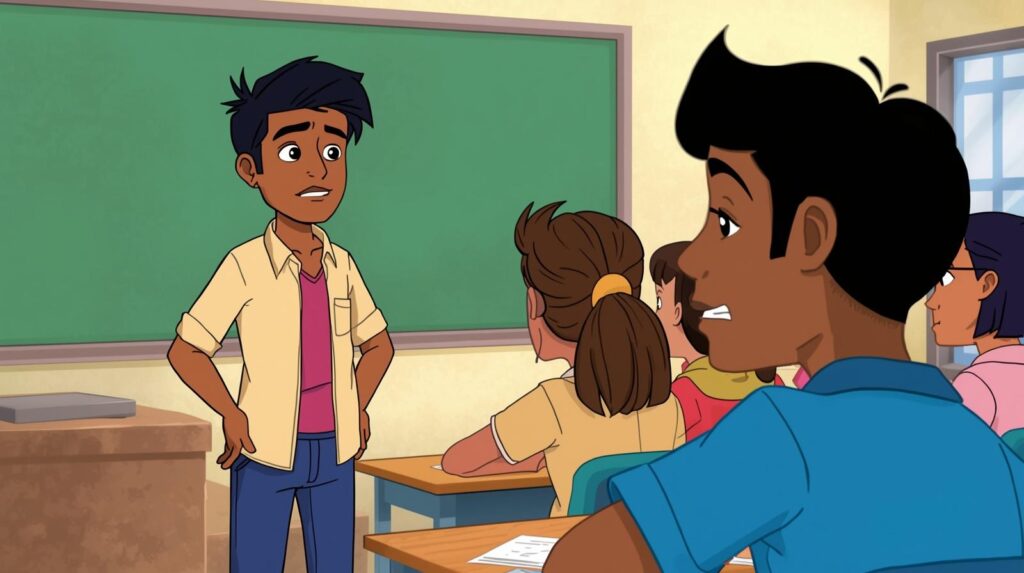
Why Does This Happen?
Secondhand embarrassment isn’t random. It comes from a mix of how our brains are wired and how we’ve learned to function socially.
One big factor is empathy.
When you see someone in a socially awkward situation, your brain activates similar emotional pathways as if you were experiencing it yourself. It’s almost like a simulation:
“What would this feel like if it were me?”
Another reason is our deep need to follow social norms.
We are constantly, often unconsciously, scanning situations for what is “appropriate.” When someone breaks those unspoken rules—talking too loudly, oversharing, missing social cues—it creates tension.
Your brain flags it as:
“Something is off.”
That discomfort doesn’t just stay in your head. It becomes a physical and emotional reaction.
There’s also something called self-projection.
Sometimes, the reason something feels extra embarrassing is because it reminds you of your own past mistakes. You’re not just reacting to them—you’re reliving a version of yourself.
The Signs People Often Overlook
Secondhand embarrassment isn’t always obvious. It can show up in subtle ways people don’t recognize right away.
For example:
- Laughing nervously even when nothing is funny
- Avoiding eye contact during awkward moments
- Feeling drained after social situations without knowing why
- Judging others more harshly than usual
- Wanting to control or “rescue” situations
Sometimes, people mistake it for being overly critical or sensitive.
But underneath, it’s often just heightened awareness and empathy.
Why It Matters in Everyday Life
At first glance, secondhand embarrassment might seem like a small, harmless emotion.
But it actually plays an important role in how we connect with others.
It helps us:
- Understand social boundaries
- Develop empathy
- Navigate group dynamics
However, when it becomes too intense, it can also create challenges.
You might start avoiding social situations.
You might overthink interactions.
You might feel responsible for managing other people’s behavior.
In some cases, it can overlap with social anxiety—where the fear of embarrassment (even indirectly) becomes overwhelming.
Can We Reduce It?
You can’t completely “turn off” secondhand embarrassment—and that’s not the goal.
But you can learn to manage how strongly it affects you.
It starts with awareness.
When you feel that wave of discomfort, pause and ask yourself:
“Is this actually about me, or am I absorbing someone else’s moment?”
You can also gently remind yourself:
- Not everyone experiences embarrassment the same way
- Some people are comfortable being expressive or imperfect
- Social mistakes are part of being human
Over time, this helps create a bit of emotional distance.
Not disconnection—just enough space to stay grounded in yourself.
A Quiet Reflection
Secondhand embarrassment says something meaningful about us.
It shows that we are aware. That we notice. That we care.
But it also reminds us how tightly we hold onto social expectations—how quickly we feel discomfort when things don’t go “as planned.”
Maybe the next time you feel that familiar cringe, instead of pulling away, you can pause for a second.
Not to judge. Not to fix.
Just to understand.
Because sometimes, what we’re really reacting to…
is how human the moment actually is.
📚 References
- American Psychiatric Association. (2022). Diagnostic and Statistical Manual of Mental Disorders (DSM-5-TR).
- Decety, J., & Jackson, P. L. (2004). The functional architecture of human empathy. Behavioral and Cognitive Neuroscience Reviews.
- Miller, R. S. (1996). Embarrassment: Poise and Peril in Everyday Life.
- Krach, S., et al. (2011). Your flaws are my pain: Linking empathy to vicarious embarrassment. PLoS ONE.
- Tangney, J. P., & Dearing, R. L. (2002). Shame and Guilt.
Are you a student or simply curious? Feel free to check out my Facebook post on secondhand embarrassment—it’s different from the blog version, as it’s designed specifically for students who want to take notes.
If you enjoyed this topic, you might also like:
- It’s Not Just a Bad Day: What Major Depression Really Feels Like
- Acute Stress Disorder: When the Mind Is Still in Survival Mode
- People Change More Than You Think—Here’s the Powerful Reason Why
More psychology articles are also available on my website.