
This article is for informational purposes only and does not substitute for professional mental health support. If you’re experiencing relationship patterns that feel difficult to break, consider speaking with a licensed therapist or counselor.
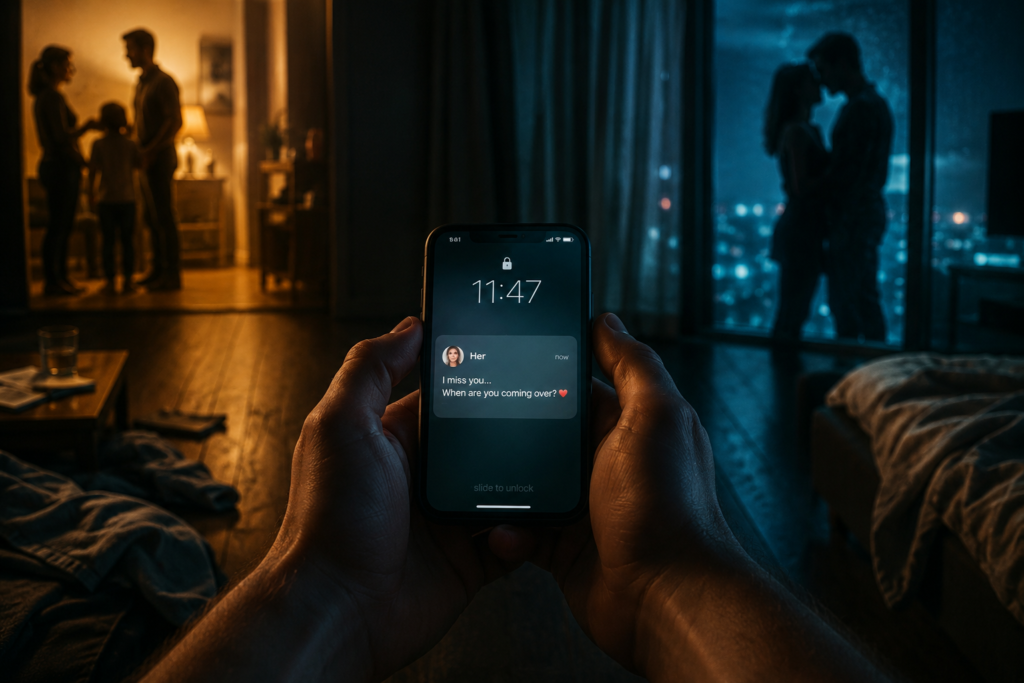
It’s 2 a.m., and you’re staring at your phone. Again.
You’re not waiting for just anyone. You’re waiting for someone who isn’t fully yours: someone who goes home to another life, another bed, another person. And yet, here you are. Checking. Hoping. Waiting for a message that may or may not come.
Maybe you’ve told yourself a hundred times that you’ll end it. Maybe you already have: twice, three times. You’ve cried in your car after a last-minute cancellation. You’ve written the “we need to stop” message and then deleted it. You’ve convinced yourself you deserve more, felt the clarity for a whole afternoon, and then answered the call three days later like nothing ever happened.
You’re not confused about the facts. You know what this is. And somehow, that makes it harder, not easier.
This isn’t a story about weakness or poor judgment. It’s a story about how the human brain works under conditions of emotional intensity, deep longing, and uncertainty. Because once you understand what’s actually happening underneath all of this, a lot of things start to make a surprising amount of sense.
What This Feels Like in Real Life
When most people hear the word “affair,” they picture something dramatic. Stolen hotel rooms. Reckless passion. Two selfish people who simply didn’t care about the damage they were leaving behind.
But the reality is usually quieter than that, and far more complicated.
Most people stuck in an affair don’t feel powerful. They feel split. They feel deeply chosen and deeply invisible at the same time. They know, on some level, that what they have isn’t whole. They’ve Googled “how to stop loving someone unavailable” at midnight. They’ve had the conversation with a trusted friend who very kindly told them to walk away. And they still couldn’t.
That’s not moral failure. That’s not a lack of intelligence. That’s something that has roots much deeper than logic in the way your brain processes love, reward, hope, and loss. And understanding those roots is the first honest step toward anything resembling freedom.
What’s Actually Happening in Your Brain
There’s a term worth knowing here: limerence.
Psychologist Dorothy Tennov introduced it in the 1970s to describe an involuntary, intense form of romantic fixation. It’s that particular kind of longing, the intrusive thoughts, the emotional highs when they reach out, the crushing lows when they go quiet, the way your entire day can pivot on a single message. Limerence isn’t quite the same as love, though it often gets mistaken for it. It’s more like your brain getting stuck in a loop of wanting and seeking, unable to settle.
Now layer on top of that something called intermittent reinforcement, and things get even clearer.
When a reward comes inconsistently and unpredictably, the brain doesn’t give up. It doubles down. Think of a slot machine: you don’t win every pull. You lose most of the time. But the occasional win keeps you sitting there, quarters in hand. Affairs have this same quality almost by design. The stolen Tuesday afternoon is followed by two weeks of silence. The “I miss you” text arrives out of nowhere after a cancelled plan. The warmth comes and goes without warning. That inconsistency doesn’t cool the attachment. It amplifies it. Your brain’s dopamine system, which governs reward and motivation, fires more intensely when the reward is uncertain. You’re not chasing the person. You’re chasing the feeling of finally being reached.
That’s not a character flaw. That’s neuroscience.
The Attachment Piece
Psychologist John Bowlby spent decades exploring the way humans form bonds. And what he found was this: the way we learned to be loved as children becomes the emotional template we carry into our adult relationships.
People with an anxious attachment style, often those who grew up in environments where love was present but inconsistent, or where affection had to be earned, tend to experience relationships through a lens of heightened vigilance. They’re more sensitive to perceived withdrawal. They work harder to maintain closeness. And they’re more vulnerable to the specific kind of dynamic an affair creates: one where love is real but partial, where connection comes in waves rather than a steady flow.
For many people, an unavailable partner doesn’t feel foreign. It feels familiar. And familiar, even when it’s painful, registers in the nervous system as safe.
The Real Pull: Trauma Bonding
There’s one more concept that explains a lot, and it’s called trauma bonding.
Dr. Patrick Carnes, who studied addictive and exploitative relationship dynamics extensively, described trauma bonding as the deep emotional attachment that forms through repeated cycles of intensity, pain, and relief. It’s the bond that grows not despite the difficulty, but partly because of it.
Affairs are, almost by nature, emotionally extreme. The secrecy creates tension. The limited time creates urgency. The uncertainty creates craving. The moments of genuine connection, against that backdrop, feel almost electric. And when high emotion whether it’s conflict, longing, jealousy, or a particularly tender afternoon, is followed by relief or reconnection, the brain encodes that bond as powerful and significant.
So when the relationship hurts and then suddenly feels wonderful again, the brain doesn’t process that as instability. It processes it as importance. Hold on. This matters. Don’t let go.
And so you hold on.
Signs People Often Miss
Some of the clearest indicators that this pattern has taken hold often go unnoticed especially by the person experiencing them.
You’ve started excusing things you would never accept in a different relationship. The repeated cancellations. The vague answers. The promises that quietly get revised. You tell yourself you’re being understanding, but somewhere underneath, you know you’ve lowered the floor of what you’re willing to accept.
Your sense of how the day is going has become tied to their availability. A good day is a day they reached out. A hard day is a day they didn’t. Your emotional weather is no longer your own.
You feel more alive inside this relationship, with all its uncertainty and longing, than you do anywhere else. And maybe you’ve noticed that people who are fully available, fully consistent, feel somehow less compelling. That’s worth sitting with honestly, because it’s often a sign that the nervous system has gotten wired to intensity over security.
And perhaps most telling: you’ve tried to leave. More than once. But the moment they reach back out, even just a small message, even something inconsequential, the pain resets and the hope floods back in. That cycle of leaving and returning, over and over, is one of the clearest signals that what you’re navigating isn’t just attachment. It’s compulsion.
What This Does to You Over Time
Here’s what doesn’t get talked about nearly enough: affairs don’t stay contained to one corner of your life. They follow you.
Prolonged emotional ambiguity, the constant not-knowing, the hiding, the managing of secrecy, activates the body’s stress response. Cortisol, the stress hormone, stays elevated. Sleep gets harder. Focus drifts. That low-grade anxiety becomes the background noise of your daily life, and eventually, you stop noticing it because it just feels normal.
Beyond the physical toll, there’s something quieter happening to your sense of self. When you spend long enough waiting to be chosen, fully, openly, without conditions, the waiting starts to feel like the default. Crumbs start to feel like a meal. And your internal sense of what you deserve in a relationship gets recalibrated, slowly and without fanfare, downward.
That’s the real cost. Not just the heartbreak when it ends, but the subtle reshaping of what you believe you’re allowed to want.
Moving Forward
There’s no clean moment where you simply decide to stop loving someone and it works. Anyone who has lived this knows that. Telling someone to “just move on” is like telling someone to stop being hungry. The instruction doesn’t match how the body actually functions.
But healing does happen. Not all at once, and not in a straight line.
The first real step is usually understanding rather than willpower. Not analyzing the other person, not building a case against yourself, but genuinely looking at what this relationship has been doing to your nervous system, and what it’s been telling you about what you believe you deserve. That kind of self-honesty is uncomfortable. It’s also the kind that actually holds.
Therapy helps significantly here, particularly approaches like Emotionally Focused Therapy (EFT) or attachment-based therapy, which work underneath the behavior to address the patterns that drove it. For those without access to professional support, journaling with genuine honesty (not just venting, but questioning), conversations with one trusted person who can hold space without judgment, and deliberately sitting with the discomfort instead of immediately soothing it with contact. These all matter more than they might seem.
The goal isn’t to hate the person, or to hate yourself for staying as long as you did. The goal is to gradually, honestly, become more interested in what a complete life feels like than in what the next message says.
That shift is slow. But it is real.

A Quiet Thought to Leave You With
Psychotherapist Esther Perel has written that the quality of our relationships determines the quality of our lives. Not just the romantic ones but all of them. The way we let people in, the way we protect ourselves, the way we define what connection is allowed to look like.
The deeper question underneath the affair — the one worth sitting with when the noise dies down — isn’t just “Why can’t I leave?”
It’s: “What kind of love do I actually believe I’m allowed to have?”
Because more often than not, the reason we hold on to something incomplete isn’t that we don’t know better. It’s that some part of us isn’t yet sure that something whole is possible for us, specifically, given everything.
It is. It just doesn’t look like what you’ve gotten used to. And that difference, at first, might feel like loss. Give it time. It isn’t.
References
Tennov, D. (1979). Love and limerence: The experience of being in love. Stein and Day.
Bowlby, J. (1969). Attachment and loss, Vol. 1: Attachment. Basic Books.
Ainsworth, M. D. S., Blehar, M. C., Waters, E., & Wall, S. (1978). Patterns of attachment: A psychological study of the Strange Situation. Lawrence Erlbaum Associates.
Carnes, P. (1997). The betrayal bond: Breaking free of exploitative relationships. Health Communications.
Fisher, H. (2004). Why we love: The nature and chemistry of romantic love. Henry Holt and Company.
Perel, E. (2017). The state of affairs: Rethinking infidelity. Harper Collins.
Skinner, B. F. (1938). The behavior of organisms: An experimental analysis. Appleton-Century-Crofts.
Mikulincer, M., & Shaver, P. R. (2007). Attachment in adulthood: Structure, dynamics, and change. Guilford Press.
Johnson, S. M. (2008). Hold me tight: Seven conversations for a lifetime of love. Little, Brown Spark.
If you enjoyed this topic, you might also like:
- They Never Say Sorry — What Narcissism Really Looks Like
- When Your Actions Don’t Match Your Values-Explained
- Hoarding Habits Are Draining Your Energy but You Can Change Them Step by Step
More psychology articles are also available on my website.
If you prefer reading on Medium, this article is also available there.